






Striking the Sun – All Chapters
She went to the address she’d been given for the film event, and arrived at a dark church rising from a narrow street in the extremities of East London, an area simultaneously poverty-stricken and filled with the young and rich; a microcosm of London itself. Susan approached with apprehension and was confronted by a cardboard sign taped to the door. In red pen and curly writing with love hearts dotting i’s, it told visitors the event had been delayed by an hour.
Hangover finally tamed, she retreated to the nearest pub. Its door was stiff and the inside was so dimly lit it took a moment for her eyes to adjust. A dozen black faces looked up at her. She looked around the cramped space, could see only one seat, in the midst of the strangers. For a moment anxiety burned her to the spot, a fear she was somewhere she shouldn’t be, and then behind the bar she noticed another room, better lit. To get there, she had to squeeze down a narrow connecting passage past the toilets.
It still wasn’t especially pleasant, but this side was quieter and less hostile, just an elderly white man drinking at the bar. She wasn’t sure she belonged in an apparently racially segregated pub, but on an evening like this it would take a lot for cold and sober to beat warm and drunk, so she took to a seat by the old fireplace. This room had its own entrance, she discovered, meaning neither set of patrons would ever have to meet.
Because she was trying to have a discreet drink, what happened next was inevitable. He was old and round and red-faced, dressed in jeans and polo shirt with blim burns around its waist. When he’d walked in the other man had immediately recognized him, and then he’d bought a drink and talked to the barman, and now the logical conclusion was to be looming over her.
“I’ve never seen you in here before.”
“No.”
“Can I get you another glass of wine, lady?”
“I haven’t finished this one.”
“What’s your name?”
“I’m sorry,” she said. “I don’t want to be rude.”
“Eh?”
“I’m terribly busy.”
“You don’t look terribly busy.”
“Please.”
Her suitor returned to sit with the man who had greeted him earlier, who commiserated with him by way of a slap on the back and a laugh.
Two glasses of wine and an hour had passed, but when she left the pub the cardboard sign was still present outside the church. She pushed the door and a young man’s face poked around the corner.
“Sorry, we’ll be ready in a couple of minutes.”
Thirty minutes of cold air later, the doors finally opened. As soon as Susan got inside, a stream of people arrived behind her as if they knew. She felt out of the loop.
The old church was bordering on being a ruin. It had looked worn down from the outside, but inside was worse, coated with dust and thick black smudges, one of which rubbed off onto the arm of her jacket. The walls were bare, the damp plaster falling away in parts, and the floorboards creaked and wobbled beneath her feet. She wasn’t sure this wasn’t some kind of squat, a broken-into derelict church being appropriated by shitheads with haircuts.
The first short on the bill was by an eighteen year old kid who’d just finished his A Levels in Film Studies. It was called Striking the sun and was accompanied by an A5 sheet of paper that stated, in a typeface betraying the creator’s lack of understanding of design arts, any written coverage of the movie was to apply the auteur’s specific case setting whenever referencing its title. And then in case you didn’t get it: “Striking the sun NOT Striking the Sun.” Susan made a note asking if this was to differentiate it from an existing work of art. On the other side of the paper, the director’s self-penned biography described himself as being born and raised in the Soviet Socialist Republic of Humberside, which wasn’t funny, and said he’d originally chosen to use DV as a medium because he thought it stood for Dziga Vertov, which Susan would have to check but had been taken enough by La Jetée as a teenager that she was pretty sure the author was paraphrasing a joke by Chris Marker.
At the altar, a young man in large black-rimmed glasses hung a white bed sheet above and threw a broom handle inside to keep it hanging firm. A projector propped up in the nave on top of a pew cast a blue screen with the words ‘Waiting for input’ on the sheet. The lights went out. Everybody stopped talking. They sat in silence in the blue glow watching the projector’s input counting down to automatic standby, before one or two people began to speak, and the chatter recommenced. They were discussing directors she’d never heard of, movies she’d never seen, plotlines that sounded ridiculous.
She felt old being here. For a couple of years she’d loved difficult cinema and it still held something for her—she’d only seen Werckmeister Harmonies once, but when she’d first moved to London she’d replayed the opening scene to a guest from Bristol when she’d been very drunk, at which point she was unconcerned enough with her pronunciation that she’d even attempted its original Hungarian title, Werckmeister harmóniák (had she remembered this, the young filmmaker’s prescriptive capitals might have seemed more endearing to her).
The man with the large-rimmed glasses was up front in the blue light now, thanking the twenty or so people in the audience for coming. He started to explain what had motivated him, and Susan realized this was the filmmaker. He’d given off the impression of confidence when she’d arrived, but now he was addressing the audience his words lacked conviction. Turning around to count the number of people in the building, she realized his elderly parents were there in a pew near the back, presumably as hidden as possible because they were trying not to embarrass him too much. She thought of her own parents, so far away these days. It wouldn’t take long to get to Bristol, but distance isn’t always physical.
The man was still talking. Rumbling run-on sentences that went nowhere. It’d be mean to do her usual hatchet job on a bunch of teenagers who likely didn’t understand their own visual art very well at all and seemed so young in trying to behave so old, but who were also ambitious enough to set this evening up to be seen, and not yet jaded enough by the world that they wanted to just give up and take the low-status job and turn their attentions to alcohol to take away the boredom and feel okay about wasting their lives doing something less than they were worth.
The old stained glass window was crusted with dirt, but with the lights out Susan could make out its design beneath the grime and cobwebs. Loinclothed Jesus was ripped with bulging muscles all down his arms and chest. His right leg was cocked up on a globe, and the strips of color behind his torso looked like the American flag. She wondered how many laughs she could squeeze out of the church itself. She wrote: Gay Captain America?
Striking the sun started. The first shot lingered on an indistinct shape, something that looked like an inverted star that had obviously been achieved with in-camera effects, but Susan didn’t know what the object would have been originally. A man with his shirt off, filmed from top of doughy chest to bottom of double chin. Trees followed, and then a field. A close-up of branches swaying in the wind. The shadow of tree branches on grass. None of this was filmed with a tripod.
“The man who stared at the sun too long. Nothing went wrong, but what else could he do? When you’ve given up everything you’ve got, sometimes it’s easier to lose,” said the voice-over, an almost rhyme.
The auteur attempted to capture drudgery. He’d picked quick visual metaphors for working a job you hate, using imagery that didn’t resemble any job that exists, a child’s portrait of what they think a job is, a teenager’s terror in entering adulthood. Alarm clock. Tie. Keyboard. Word processor. Food. Bed. All filmed close-up and avoiding the man’s face. Susan wondered if this was the filmmaker starring in his own movie. She wondered if all this was being filmed at arm’s length.
The day-to-day went on too long. An exhausting montage of symbolism for adulthood, the same seven shots recreated afresh each time, Susan noted, and was sure it was terribly important for the filmmaker to have done this, to have suffered this artificial misery to depict the hidden day-to-day tragedy of life. The blood of a poet, Susan wrote.
Nobody had tried to disguise that the camera was resting on a coffee table in the next shot. When she was a teenager writing screenplays in her bedroom, she’d picture how they’d look when filmed. She recognized these shots born of that, letting the daydream take precedence over the realities of the craft.
She tried to refocus on the screen. A close up of an eye, presumably reading, though for some reason this was a static image. A voice-over explained the story of a woman who dropped dead in a park. She stood there, staring forward, upward. Nobody could rouse her from this stasis. And then she crumpled, dropped dead. Nobody understood what happened.
Drudgery, again, because Susan clearly hadn’t seen enough of that, followed by the lone man having, what, an epiphany? Constipation? Followed by a field. Followed by our hero striding purposefully, the camera sort of thigh-high and shaky.
Her father found her scripts and responded with anger. She’d had flashbacks to reading Matilda in primary school, but he wasn’t angry at the act of writing. He was angry at the content.
The man stood in the middle of a park. He understood what the dead woman was doing. He stared at the sun. The trees blew in the wind. In their shadows, the shape of the man silhouetted on the grass.
The music started, and Susan was reasonably sure the estate of Nusrat Fateh Ali Khan hadn’t given the filmmaker permission to use this song. A beautiful piece of music, but a less-than-beautiful shot. The camera began to spin around the protagonist, starting at his feet. The shot shook from the cameraman’s hands (the auteur’s mother, perhaps?), moved up and down with each step the unseen camera operator took around the protagonist, and captured families picnicking in the background, giving literally not one single shit about the man staring at the sun until he died. The camera finally reached his face and lingered over his eye, moved in slightly, and dropped out of focus just a little. Fade to black, like our protagonist’s sight and his grip on the mortal coil.
Her father didn’t like her scripts, nor what he found out about his daughter. He wanted to read stories where girls fall in love with boys instead of with other girls. She packed her writing and a change of clothes into a backpack, and before walking out of the door made her confession, about the existence of a young woman who’d later come to visit in London and they’d watch the opening of Werckmeister Harmonies together and then never see each other again. It was the day before her 18th birthday when she walked into the Globe’s office in London, and she couldn’t withhold a smile when Jonah praised the scripts.
Fade back in. Shadows of branches on the grass waved over the spot once occupied by our protagonist’s silhouette, the fades to black having only teased of the film’s end. The branches swayed for several minutes until the music ended.
Susan understood what the author wanted to produce, she thought. The attritional tragedy of adult life, and finding release from this tragedy through obsession; a damaging, killing pursuit that took over the protagonist’s life, but one that offered a release nonetheless. An opt-in reality that maybe wasn’t quite as real but at least felt more fair.
I didn’t sit next to Amanda Grass again, but I admired her from a distance. I recognized what I was, that is, as far as any teenage boy recognizes what he is, which is to say, I recognized my social role within the school, the diffident outcast, and I determined to fix it to be more desirable to her. What I saw in the other boys who, I presumed, were attractive to the girls, even to girls like Amanda Grass, I believed I replicated with success, becoming boorish and barbaric. Knowing she was a lost soul, I cultivated that element of my personality too, producing a me who was simultaneously the worst of both worlds, or, as it was, the most despicable, undesirable, unpopular character I could be. I missed the mark, landed miles from the target as a self-conscious show-off who still couldn’t meet her eyes.
I wanted to be profound beneath the bravado, and wrote abstruse poetry I hoped she’d discover during classroom interactions that only ever happened in my head, and then she would see the tortured soul within of a fellow lone wolf. The poetry was usually little more than a proclamation that I liked her and that she didn’t know, which, by and large, wouldn’t do much in the grand scheme of showing her my soft and unusual center. In short, the prize I held for her was as ramshackle as the shell I’d built to contain it, and in retrospect Amanda was wise to treat it with wherever it was she’d landed on the continuum between obliviousness and contempt on any given day.
It was as I was finishing school and Amanda Grass still wasn’t interested that Liam said to me the words you can probably predict he said.
“I’ve got a girlfriend.”
Somehow I knew who it was going to be. There was a small pool of mates to choose from between our two towns, and even though I felt as though I’d decided on a diamond only I could see the beauty of, I wasn’t naive enough to believe it. Liam would, of course, desire the intelligence and nonconformity and the adult female body shape I had discovered and told not a soul about.
“She’s called Amy. Says she’s a friend of yours.”
And so on, where I humbly admitted we’d shared a couple of classes together and I was aware of who she was, and congratulated him on becoming a married man, or some other such nonsensical thing, because I was still a teenage boy and what do teenage boys say to teenage boys who get girlfriends, even when said girlfriend has been the object of distant desire for the teenage boy for such a long time?
The development team called me with the good news the week before my exams, and I skipped the lot. I used the exam period instead to ride and then trained through the winter while my peers went on to college. They’d taken Liam on board too, and he treated the culmination of his schooling with the same reckless abandon as I did.
Our two-year stint was funded by charity. It wasn’t much of a team and we weren’t getting paid, but it was a good deal for us. They delivered my free bike and a jersey that read “Bike to the Future,” and I rarely got my entries rejected from any of the British races I could hitch lifts to.
My only obligation was to attend their fund raising dinners and stand on stage to be interviewed by a skiing commentator from some tiny niche sports TV channel. He compered for free in exchange for the access he’d get to us, because he ran a decidedly undistinguished sports PR agency from his kitchen table in his spare time. Whenever I was near him, he’d shove business cards into my hands. It was the same for all of us.
I soon realized the deal wasn’t as sweet as it had seemed. The Royal Society for Cycling was broke, and what we’d already gotten was all we’d ever get. Heavy bike, garish jersey, and a pat on the back to encourage us. If we had a team presence at an event it would be because chance had meant two or more of us had entered the same race.
My time on the team went fast, largely because I was so busy training and racing. There were few hindrances of any real of consequence, and so I won’t dwell too much on this period. There was one incident, though, that summed up these two years.
It was during our second year on the team. Liam and I hadn’t changed much: we continued to ride our bikes during the day and mess about at night. This night was a usual night. We were in my room playing video games and listening to music so loud we couldn’t hear each other speak. I’d become acutely aware of a banging noise underneath the music, and just as I realized what it was, it was too late. My mum threw the door open.
“Couldn’t hear me? I’m not surprised. Come out here, please,” she said. “And Liam darling, can you turn the music down for me?”
We sat facing each other in the kitchen, at the table covered in unironed clothes and unopened mail.
“You’re eighteen Dominic.”
“Yeah, I noticed.”
“Are you going to keep living in my house and spending my money? Do you think you’re using your life wisely?”
“I’m on a cycling team. I’m a professional athlete.”
“They’re not paying you, love. I pay your way. I know you’re one of the best”
“The best.”
“The best—”
“The best junior. National champion. Only in the time-trial though.”
“I know, and I’m pleased you’ve done so well, but what’s being the best worth? You play computer games with Liam all night, it’s all you ever do.”
“I’ll sign for a team, and then I’ll be earning more than anyone I went to school with. Do you think I’d be better off serving fast food or working as an estate agent?”
“Your grandad thought you’d be the first person in the family to go to university. If you’d used these two years to study you’d have A-Levels by now. I was in Northallerton and saw an advert for enrolment at the university and it upset me because that should’ve been you.”
“I won the Girvan three-day,” I said, knowing it wouldn’t mean anything to her. I had won it though, back in April, thanks to a lucky opening time-trial and perseverance through the rest. Bar the national champion’s jersey, it was the only thing I’d won all year. “They’re queueing up to sign me. Trust me, it’s going to work out.”
The stalemate drew to its end. When I returned to my room, Liam had turned off the music. He was skimming over my bookshelf.
“I should go, mate.”
“See you tomorrow?”
“No, Thursdays and Fridays I spend with the A-bomb.”
“You can’t call her that.”
“I assume you’re racing something bigger than Shipley this weekend. Guess I’ll be over next Monday.”
Real life was beginning to filter in, and because we were still kids, it was all on our parents to support us. Almost everyone on the team was a working-class northerner, as you’d expect, because of the landscape and limited prospects to distract able-bodied young men. None of us came from a background of money.
There was a reason we persevered. Our charitable benefactors from the Royal Society for Cycling had a relationship with a professional team, LaxRelief, who’d get first pick of us. LaxRelief was set up as a proper team, with the management structure and vehicles and training camps and all the other things you’d expect. Most importantly, they paid their riders.
I knew LaxRelief would want to take me. Although it sounds arrogant, it seemed like I’d be able to pick any British pro team and make a small wage. There was only one team I’d consider though. LaxRelief had been the goal when I signed up with the charity team at 16, and it was the natural progression, the link I needed from my life in Sedgethorpe to the glamour of Continental Europe. As if to assuage any doubt, they’d been making a big fuss about their European ambitions for next year.
I was relieved when their contract offer arrived, but I played it cool. Three days later, I found out Liam had been playing it cooler: they had signed him as well.

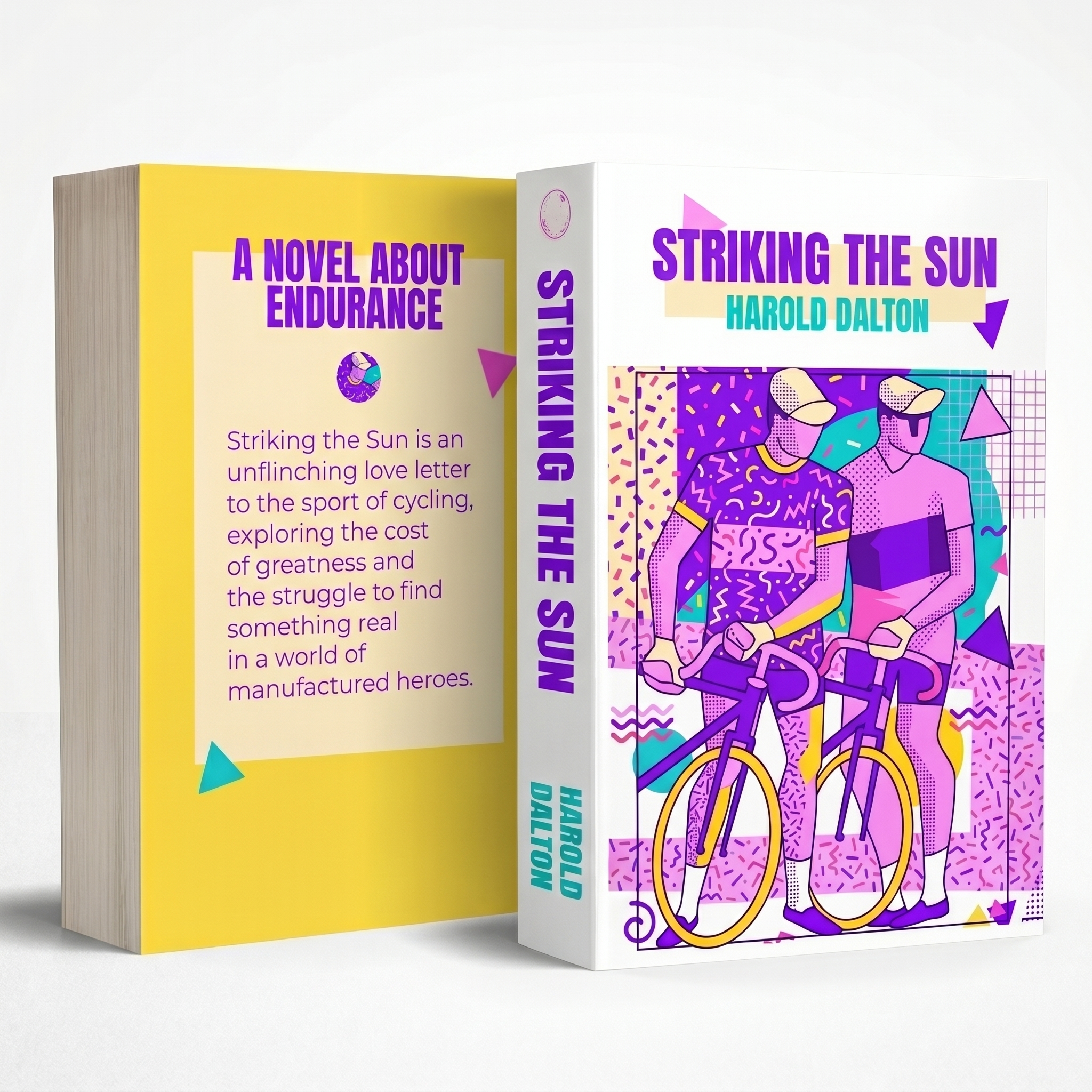
Hold it in your hands
The complete serialized novel is also available in a limited physical print run.
VIEW THE PAPERBACK →


