






Striking the Sun – All Chapters
It wasn’t as if fate threw us together, but as teenagers, it felt like it.
I grew up in Sedgethorpe, North Yorkshire, a small town built on grey stone and surrounded on three sides by fields of ragged sheep and one side by a worn-down industrial park full of vacant lots, a motley scarring of buildings poking out from the countryside. The kind of place you couldn’t blow your nose without the news spreading around town. Where there were pavements they were narrow, and usually even this grace wasn’t afforded; the morning stream of schoolkids walked slanted in the downward camber of the road to reach the bus stop, their bags and jackets scraping against drystone walls whenever a car approached. To look out over the valleys was beautiful, but by our teenage years the realities of life in Sedgethorpe had exhausted us all.
And yet despite the exhaustion there was a sense of local pride in all of us, some feeling that although we’d grown weary of the only life we’d ever known, to hear an outsider express the same sentiment was a mortal sin. Knowledge of Sedgethorpe’s great rivalry with an even smaller town called Richfield had passed from kid to the kid and naturalised within us all. Sedgethorpe and Richfield are only a mile and a half apart, and it seems as adults it’s common to come and go between the towns for a lunchtime walk or afternoon shopping, but as kids we had no reason to visit our rival town. Despite its proximity, Richfield was in a different school catchment area, two sets of buses arrived in the two towns, taking the children in two different directions to two different schools, ours in Romanby, theirs in Thrintoft.
The schoolyard in Romanby was run by two mammoth bullies, both called Paul, and they would often posture, announcing we were going to bang the kids from Richfield after school. They’d drag me out with them and we’d wait on the far field for opponents who would never show up because they had no knowledge of the war we’d declared. When boredom set in, the Pauls would pick one of us and we’d mock him, surround him, throwing things so he’d spend the next hour fending off twigs and stones. I participated in this deed the first few times, and then one day the victim was me, and then it was always me.
The Pauls made my early teenage years less pleasant, but they were just a symptom, victims of the same small-town ennui from which I was suffering. Getting anywhere beyond Sedgethorpe became a goal. One day I just got my old bike out of the shed, found an empty road looking down into the valleys, and let the bike roll far down in a direction I’d never needed to travel. Returning up the deserted climb flooded my legs with lactic acid, but felt like a triumph too, over the geography that had bound me to Sedgethorpe, and over my own body.
It soon became habit. I’d ride to nearby towns, eat an ice cream or some chips, and then ride home, while the Pauls loitered in bus stops or on the high street back in town with their beleaguered friends.
I began to ride to school. Riding taught me new things about the bus route I’d travelled so many times passively. Which sections were open to the wind, which had rough surfaces, which were on an incline. It was astounding.
One day I saw the tired old school bus spluttering through the lanes, its roof visible above drystone walls, and began to pursue it. It didn’t take long for me to reach the same stretch of road as the bus, and then its back bumper, so close I could feel the heat from its exhaust. The Pauls were sat on the back seat, laughing at me through the window, throwing me the Vs. I pushed myself and overtook, sparing a moment for a savoury sideways glance at the shocked faces of my two tormentors.
My rides began to upset my mother, who insisted I join a cycling club for safety in numbers. It was her idea to talk to the Sedgethorpe Road Club, having consulted with her work colleagues and discovered Rich from accounting was a member, and it was her who put them in contact with me. It felt restrictive at first, like a punishment—I was cycling for my freedom and to explore new places, and didn’t appreciate being lumbered with racing cyclists who didn’t appreciate the joy I took simply in riding at my own pace, whose rigid routes contrasted with my chaotic approach. I see now it was more permissive than a parent might usually be of a hobby they didn’t understand.
You’d think my new-found athleticism would have made me popular in school, but cycling was so niche and detached from schoolyard sports, and my training so separated me from my discontented peers, it often felt I was on different planet.
Football held nothing for me. The ball would fold and flatten under my foot and then bounce us both our separate unintended ways. All I could do was run faster and for longer than anybody else on the pitch, which didn’t count for a lot. Moving faster toward a ball I couldn’t control or a player I couldn’t halt really achieved nothing, and soon I stopped turning up to physical education classes at all.
I began to spend the hour at home instead. The timing of the class usually meant that I could watch whatever race was on television at the time, which wasn’t a patch on actually riding my bike but was maybe the next best thing. Then I could walk back to school for the start of Science. Nobody ever seemed to notice except the one time there was fog on the race finish line and everything overran and there was nothing I could do to pull myself away and not turn up late and sheepish in the doorway of the lesson that had already begun, Amanda Grass’s eyes staring at me from the back of the class like I was wasting her time.
I didn’t have much in common with my classmates anymore. Looking back, I think most people don’t at that age, but I felt aware of it even then, without the need for reflection, so I failed to make the contingent bonds others were able to create.
This isn’t a sob story, it’s just to explain that when I became friends with Liam, which still wouldn’t happen for a while yet, it was a type of friendship I’d never experienced before. I had found a peer who appreciated my cycling ability, and who shared my passion for the sport. He was smart, and I wanted to be able to talk to him all the time, not just out of necessity.
He never mentioned it, but even then I suspected Liam was in a similar position. Cycling’s a sport for the escape artists, but it can sometimes be hard to tell whether it attracts or creates them.
Sedgethorpe Road Club was small, and the few members close to my age were the children of senior members, forced into riding. They were slower than me, and less mature, and would disappear from club runs for weeks on end and then blame their absence on schoolwork. In this sense, even cycling left me simultaneously isolated from and surrounded by peers I couldn’t comprehend, and I spent my time with the old men, and the weirdos, and the victims of midlife crises, who had bikes that cost more than a stagiere’s annual wage.
And but so then Liam arrived one day out of the blue, to a Tuesday evening ride I missed because of, and I appreciate the irony of my excuse, schoolwork my mother had discovered I was falling behind on.
“That Liam’s pretty good,” Dave said, spitting over his shoulder. I’d ride with him most Wednesdays, a constitutional taken in lieu of a science class. Dirty Dave was 27 but seemed to prefer to ride alone with us youngsters, where he could bully and impress and dominate. When other adults were around, he’d retreat into his shell. “You know he’d never been on a bike before?”
“So he just learned to ride on the club run?”
“He saw the Tour on TV and mummy bought him a new bike. Yesterday was his first time on a road bike properly. He’d be a natural if he lost a few kilos.”
Even though I’d never met Liam, the old boys at the club pressured me to befriend him so he’d stick around, and because I was under pressure, I hid myself away. I didn’t even speak a word to Liam until his third time out with the club, when he inched up beside me. He rode an aluminium American bike, which looked brand new, or nearly new. Compared to my old steel frame, assembled with spare parts I’d borrowed from club mates, it was decadent, and it disgusted me that he could have a brand new bike just by deciding he wanted to try cycling. Through his white World Champion bib shorts, I could see he was wearing striped boxer shorts. His socks were too long, his arse was too fat, his chest was too developed.
He wasn’t a cyclist, not to me.
“Are you riding the club ten on Wednesday?” He said.
“Yeah, you?”
“It starts at 6.15, yeah?”
“Around then.” And then a corner and a junction and we went our separate ways in the group and our first conversation was completed.
The club ten was a casual ten mile time-trial. It started in a dirty layby that would need to be swept clean of broken glass every week, and took us around some quiet roads in a run-down industrial estate just outside town. A sea of grey looking out beyond to even more grey, the motorway. Had you not known the town’s other three walls were green with pastoral land, you’d never have guessed.
The circuit was 4 ½ miles long, which meant two-and-a-bit laps that had presumably been measured and mapped once but now the wrinkled old time keepers simply knew where to stand, a secret passed down through the ages. There were only left turns, which meant in theory you could get round without stopping. Very rarely it meant diving out of a street ahead of an oncoming car, but people who encountered this usually found the adrenaline rush reflected well on their time.
So, a time-trial works like this: each rider sets off individually at regularly timed increments, usually one minute. The timekeeper writes down your finish time, and, knowing your start time, is able to tell how long it took you to travel the course. The fastest time wins. If you overtake the person who started in front of you, that can be humiliating for them, but the only thing that counts at the end is how fast you travelled the course.
The French call it the “contre-la-montre,” or “against the clock,” more poetic in its rhythm than our “trial,” but no more symbolic. The British consider it the purest form of competition: one man, alone, racing not only against others, but also himself, and against the passage of time. What an existentialist statement about all our lives, really. The more I thought about it, the more I was drawn to the discipline.
In the big races, the order of the riders is dictated by their overall standing in the race, starting in reverse order so the best riders leave last. This is because last place is the best place to be in a time-trial: you know the times you need to beat.
In our club tens, we simulated the professionals as best we could, but the illusion would slip. Some of us would have to start earlier than we’d like so we could be home in time for dinner, and the ones going last wouldn’t have anybody else’s times relayed to them.
Liam arrived after everybody else, with tri-bars clipped to his bike to lower and extend his position and make him more aerodynamic. As an unproven teenager, he should have gone first, but four people started ahead of him while the old boys reiterated how it all worked.
“Now, you don’t start when I say ‘one’ okay? It’s ‘three, two, one’ and then you go. Do you know the rules?”
“Don’t I just ride?”
“We time you the whole way around. It’s ten miles long, so you have to go around the, uh, the corner, all of the corners, but when you get back here you have to do another lap around all the corners again, but don’t stop when you see me a second a time, because—”
“Look at him, taking this so seriously,” I said to Rich. I always preferred when Rich was there, the quiet family man who worked with my mother. We were stood on the verge next to the layby, the grass beneath us all torn up by car tyres. I kicked at a spark plug on the ground.
“He borrowed the tri-bars off of Dave,” Rich said. “It’s going to be interesting to see what kind of a time he does.”
I started three minutes behind Liam. I hadn’t been offered the loan of a set of tri-bars, but riding in the drops of my handlebars went some way to reproducing their aerodynamic effect. The bike moved like it was possessed, all those tiny actions coming up just right, a perfect run. I flew into the second corner, swung my bike through it with my knee stuck out, and then stood up out of the saddle and pushed all my power through the pedals. And then I sat down and spun at that speed. It took me no time at all to catch Rich, sweating buckets with his young son singing in a trailer on the back. I gasped and weaved through the lanes until I could see a speck in the distance, and before the final corner I caught Liam Greene for three minutes. I controlled my breathing and checked my pedalling before overtaking him with a smooth, silent grace. Not a glance or a nod, just silently powering past an obstacle, and then around the corner so fast he couldn’t hope to slipstream behind me.
The timekeeper was ahead, watching me from the side of the road with his clipboard and a stopwatch, and I sprinted for the finish as hard as I could.
I let momentum carry me down the road and slow me, and snotted out a long string out of sight of my club mates before I went back to find out my result. I arrived in time to witness Liam’s finish, saw him slam on his brakes the moment his wheels crossed the line. The old boys gasped unanimously when he skidded to a graceless stop in the middle of the road, and then the timekeeper said, “Well done Liam.”
“Dominic, if you’ve got energy to sprint then you haven’t been riding hard enough.”
When the times came in, I had won. 24’13”: a new personal best on this course. Dirty Dave was about 20 seconds behind me, which made the victory sweeter. Liam had done a 27’49” and everybody was impressed. He’d even beaten a couple of the regulars. It felt like his time got more attention than mine.
Liam’s ambition was greater than his talent, and it took him a few attempts at keeping up with us on the faster rides to realise this. For a month all I saw of him were brief glimpses, the boy on his expensive alloy bike who’d drift out of our bunch the moment the pace got higher, and then he stopped being around at all, disappearing with the old men and young children on their social rides while I continued to associate with the lean racing cyclists from the club. In some ways I was envious, but my legs had discovered the burn of racing and wouldn’t let me return to the lost days of riding for fun.
He returned to the fast group in time for a sixty mile ride in the Moors, and brought with him new confidence, moving up and down through the group like he owned it. He put his hand on Dave’s shoulder and looked over without even a wobble. I dropped back to escape the interaction.
“Alright mate?” He said.
“Big fella. Finally stopped wearing boxers under your shorts then.”
I didn’t want to hear, only to watch. I slid all the way back to the bunch. His cadence was faster now, and his legs moved in smooth, elegant circles.
After a few minutes, Dave rejoined me.
“What a cocky little twat,” he said, looking at Liam ahead. “You should have him on the climb.”
I smiled back.
“Rip his legs off,” he said.
I moved forward when the group, today only ten people from the surrounding villages, sure, but a group, approached the base of the climb. Before I could reach the front, Liam stood up out of his saddle and attacked, sprinting into the distance.
Panic rumbled from deep within me and shot through my whole body. Dave, if nobody else, knew this was a race I’d secretly signed up to, a piece of glory I was about to be denied. I upped my pace fast enough that it stretched the group from a compressed bunch to a long string, and held it there. I was waiting for the extra resistance against my wheel that meant the slope was steepening, the point of acclivity where my next effort would have the biggest effect. Behind, the elastic snapped; it wasn’t that kind of club ride today. The string flailed and then regrouped as a ball at its own pace. It was just me racing against Liam.
I caught him halfway up. There was half a mile left and it was mostly a power climb. I expected him to drift backward once caught, but he didn’t. He fought the bike and followed my wheel, gasping and panting in my ear, dripping with sweat. I pictured him as a dog about to shake rain water off its fur, and wanted to put some distance between myself and that. It hurt. Even a small climb can tear into your legs if you don’t respect it. The lactic acid burned so hard I began to fear Liam was going to catch back up to me, but when I looked under my elbow I could see his wheel several metres behind and getting further.
When I got to the summit I unclipped my shoes from their pedals and took a drink from my bottle. I got maybe ten or fifteen seconds for my heart to calm down and my breathing to regulate itself before Liam reached me.
“You flew up there, mate,” Liam said.
“I was getting a bit cold. Needed to warm up,” I said. Our clubmates climbed the hill one by one, the ball now fragmented to lone islands of men. Dave had a smile on his face like a plan had come to fruition. I wondered if he’d played me and Liam against each other. “You’ve come on a lot.”
“I think I needed to learn how to ride, like walk before I can run, you know?” He said. “Your bike is stunning.”
“It’s steel. From a charity shop.”
“An antique. Think of all the miles it must have done in the past.”
“I don’t think it belonged to Alf Engers or anything.” I said. “Where are you from? Not Sedgethorpe.”
“Richfield.”
“Don’t you have your own cycling club in Richfield?”
“Lad, we don’t even have a post box in Richfield.”
The friendship blossomed.

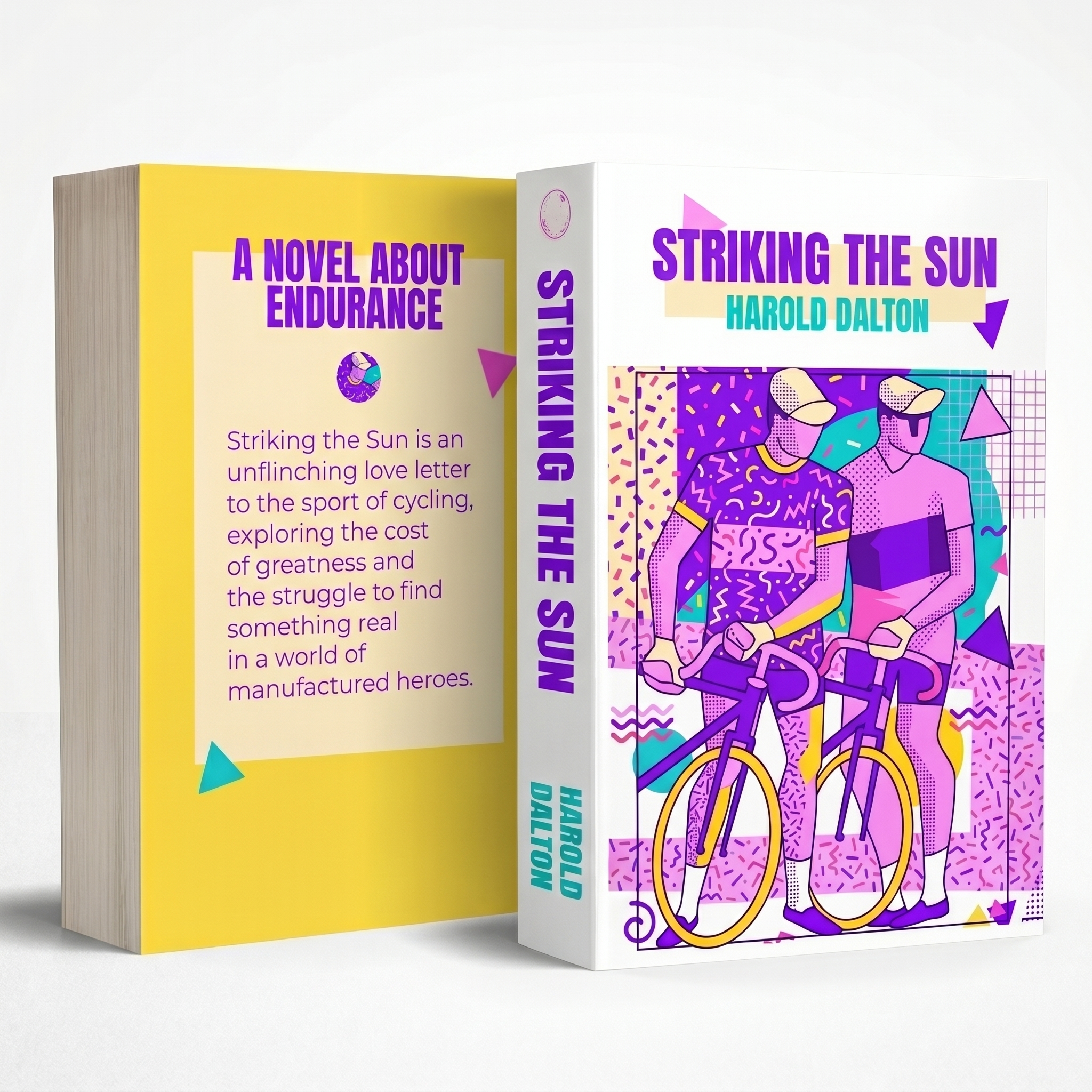
Hold it in your hands
The complete serialized novel is also available in a limited physical print run.
VIEW THE PAPERBACK →


