


There is no race in professional cycling quite like Milan-San Remo. Affectionately known as La Classicissima, the first Monument of the 2026 season is a bizarre, beautiful, and deeply flawed masterpiece. It is, by a massive margin, the longest one-day race on the UCI WorldTour calendar. Tomorrow, the peloton will clip in for a mind-numbing 298-kilometer slog that will take nearly seven hours to complete.
For the first six hours and forty-five minutes, it’s quite likely that absolutely nothing of consequence will happen. It is an endurance contest masquerading as a bike race. A doomed television breakaway will roll up the road, the commentators will run out of things to say about local Italian architecture, and the peloton will cruise along the Ligurian coastline at a terrifyingly casual 42 km/h.
But then, with roughly 25 kilometers to go, the race violently wakes up. The positioning battle becomes a bloodsport, the watts spike into the red, and Milan-San Remo suddenly transforms into the most intense, high-stakes 10 minutes in professional sports.
As we gear up for the 117th edition of the race this Saturday, March 21, here is everything you need to know about the route, the heavy hitters, the history, and how you can tune in to watch the madness unfold.
The Route: A Very Long Ride to the Seaside
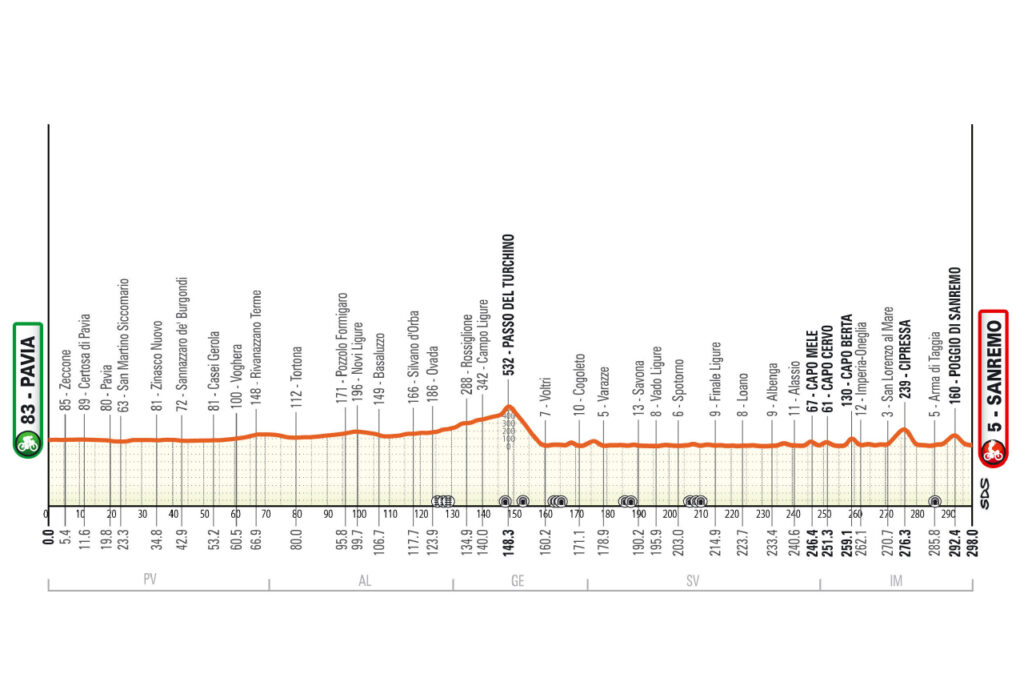
For the third year in a row, the organizers have decided that Milan-San Remo shouldn’t actually start in Milan. Due to the logistical nightmare of shutting down the center of a major European metropolis, the race now officially rolls out from Pavia, a town roughly 35 kilometers to the south.
From Pavia, the peloton meanders across the pancake-flat Po Valley. This is where the riders will spend hours casually chatting, adjusting their radios, and consuming their body weight in rice cakes. The first real geographical hurdle comes at the Passo del Turchino (km 148). It’s a long, gentle drag that serves as the gateway to the Mediterranean. Once they crest the Turchino and bomb down the descent to the coast, the race physically and atmospherically shifts.
For the next 70 kilometers, they follow the rolling coastal highway. With about 50 kilometers to go, the tension finally snaps into focus as they hit the Tre Capi—three small, punchy coastal climbs:
- Capo Mele (1.7 km at 4.2%)
- Capo Cervo (1.9 km at 2.6%)
- Capo Berta (1.8 km at 7.1%)
These aren’t mountains, but after 250 kilometers in the saddle, they act as a physiological filter. The heavy domestiques start getting dropped, the breakaway is mercifully put out of its misery, and the pure sprinters start looking nervously at their power meters.
Then comes the main event.
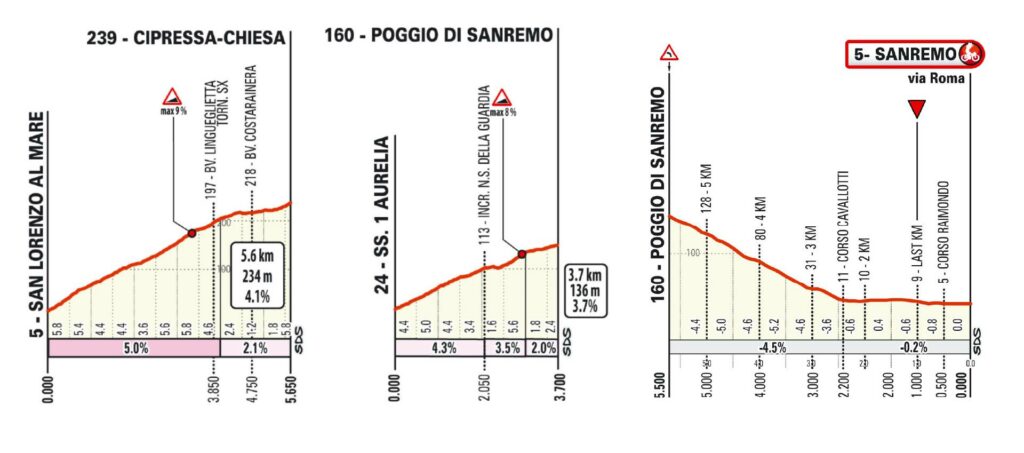
The Cipressa (5.6 km at 4.1%): Position here is quite literally everything. If you are not in the top 20 wheels at the base of the Cipressa, your race is statistically over. This is where UAE Team Emirates-XRG will inevitably put their entire squad on the front and try to set a pace so suffocating that the pure sprinters simply detach from the back of the group.
The Poggio di Sanremo (3.7 km at 3.7%): The most famous ramp in cycling. It crests just 5.5 kilometers from the finish line. It is not steep, but because the peloton attacks it at roughly 40 km/h after nearly 300 kilometers of racing, it feels like a vertical wall. This is the launchpad. This is where the race is won or lost.
From the top of the Poggio, the riders face a terrifying, highly technical, white-knuckle descent that spits them out onto the flat, wide-open tarmac of the Via Roma in San Remo for the finish.
The Contenders: Who Survives the Poggio?
Because the Poggio isn’t quite hard enough to guarantee a solo breakaway, but it’s just hard enough to drop the heavy sprinters, Milan-San Remo boasts the widest pool of potential winners of any Monument. You can win it with a nuclear attack on the climb, a suicidal dive down the descent, or a massive sprint from a reduced group.
Here are the ones to watch for 2026:
Tadej Pogačar (UAE Team Emirates-XRG) For years, Pogačar has been on a singular, obsessive mission to win La Classicissima. He has the power to shatter the race on the Poggio, and we all know exactly where and when he is going to attack. The problem is that his attacks are so heavily telegraphed that his rivals simply wait for him to launch and scramble onto his wheel. He needs his super-team—which might include Tirreno-Adriatico winner Isaac Del Toro—to make the Cipressa so agonizingly hard that nobody has the oxygen left to follow his Poggio acceleration.
Mathieu van der Poel (Alpecin-Premier Tech) The defending champion and the ultimate tactical foil to Pogačar. As we saw last week at Tirreno-Adriatico, the World Champion’s form is absolutely terrifying; he was casually using the WorldTour peloton as his personal derny. Van der Poel doesn’t need to initiate the attack on the Poggio. All he has to do is glue himself to Pogačar’s rear wheel, survive the descent, and then comfortably out-kick the Slovenian on the Via Roma.
Jasper Philipsen (Alpecin-Premier Tech) If Van der Poel decides he doesn’t have the legs to follow Pogačar, Alpecin has the ultimate backup plan. Philipsen is the fastest man in the world, and he has proven he can survive the Poggio. If a group of 15 riders comes over the top together, the race is practically over, because Philipsen will win the sprint.
Tom Pidcock (INEOS Grenadiers) Pidcock comes into the weekend fresh off a victory at Milan-Turin. He is arguably the greatest bike handler in the professional peloton. If he reaches the top of the Poggio with a five-second deficit, he has the technical descending skills to absolutely bomb down the twisting coastal roads and catch the leaders before the Via Roma.
Jonathan Milan (Lidl-Trek) The giant Italian is the ultimate wild card. Milan survived absolute carnage to win the final sprint at Tirreno-Adriatico, dropping a casual 1,500 watts in the process. He is too heavy to survive a traditional Pogačar onslaught on the Poggio, but if the tailwind on the climb is favorable and he manages to drag his massive frame over the summit with the front group, nobody is beating him in a flat sprint.
Jonas Vingegaard (Visma | Lease a Bike) The Visma team just completely suffocated Paris-Nice, and Vingegaard took the overall win with insulting ease. Milan-San Remo is usually a bit too punchy for the pure Grand Tour climbers, but Vingegaard’s current V02 max seems to defy the laws of physiology. Don’t be surprised if Visma tries to blow the race up from a long way out.
Nerd Corner: Trivia and Stats
If you want to impress your riding buddies during the inevitable six-hour viewing party on Saturday morning, keep these stats in your back pocket:
- “The Easiest to Finish, the Hardest to Win”: Because the route is overwhelmingly flat and the time cut is generous, almost everyone who starts Milan-San Remo finishes it. But because the finale is so delicate and tactically complex, it is considered the most difficult Monument to actually win. A single missed gear shift on the Poggio will cost you the race.
- The Speed Records: The fastest-ever edition was raced in 1990 by Gianni Bugno, who completed the course at a blistering average speed of 45.8 km/h. Given the modern peloton’s obsession with aerodynamics and nutrition, expect this year’s edition to push dangerously close to that record.
- The Weight Penalty: An amateur cyclist burns roughly 6,000 to 8,000 calories riding 300 kilometers. The WorldTour pros are consuming upwards of 120 grams of carbohydrates per hour just to ensure their glycogen stores aren’t entirely depleted before the Cipressa.
How to Watch Milan-San Remo 2026
Clear your Saturday schedule. The men’s race rolls out from Pavia at 10:00 CET, with the broadcast wrapping up around 16:55 CET on the Via Roma. The Sanremo Women’s race (156km) also takes place on Saturday, providing a brilliant double-header of racing.
If you don’t want to sit on your couch for seven hours watching men ride through the Italian countryside in a polite, highly-paid paceline, you can watch absolutely free highlights right here on Cyclry TV after the podium ceremonies wrap up.
For those of you who want to watch the race live, here is your global broadcast breakdown:
- United Kingdom: The live broadcast is available on TNT Sports 4 and streaming on Discovery+. (Note: Cycling coverage on TNT is shifting over to HBO Max starting March 26, but Discovery+ is still your home for this weekend).
- United States: Live streaming is exclusively available on HBO Max (or Max via Amazon Prime).
- Canada: The race will be streamed live on FloBikes.
- Australia: Great news for the Aussies—the race is being broadcast live and entirely free on SBS and the SBS On Demand platform.
- Italy: The locals can watch the action for free on the national broadcaster, RAI.
- Europe (General): Eurosport, Discovery+, or Max, depending on your specific regional licensing.
Get your snacks ready, configure your multiple screens, and prepare for the slow burn. Milan-San Remo is back, and the Via Roma is waiting.