


There is a beautiful hypocrisy at the heart of the Spring Classics. From May to September, WorldTour mechanics obsess over aerodynamics and rotational weight, shaving individual grams off climbing bikes with scalpel-like precision.
But for two weekends in April, those exact same mechanics throw science completely out the window, crack open a beer, and start bolting heavy mountain bike parts to $15,000 aerodynamic superbikes just to keep them from shattering into carbon splinters.
If you look closely at the paddocks in Antwerp this week, the bikes lining up for the Tour of Flanders are absolute Frankensteins. Here are the most unhinged, panic-driven tech modifications the WorldTour is running to survive the cobbles.
1x Drivetrains Are Taking Over the Peloton
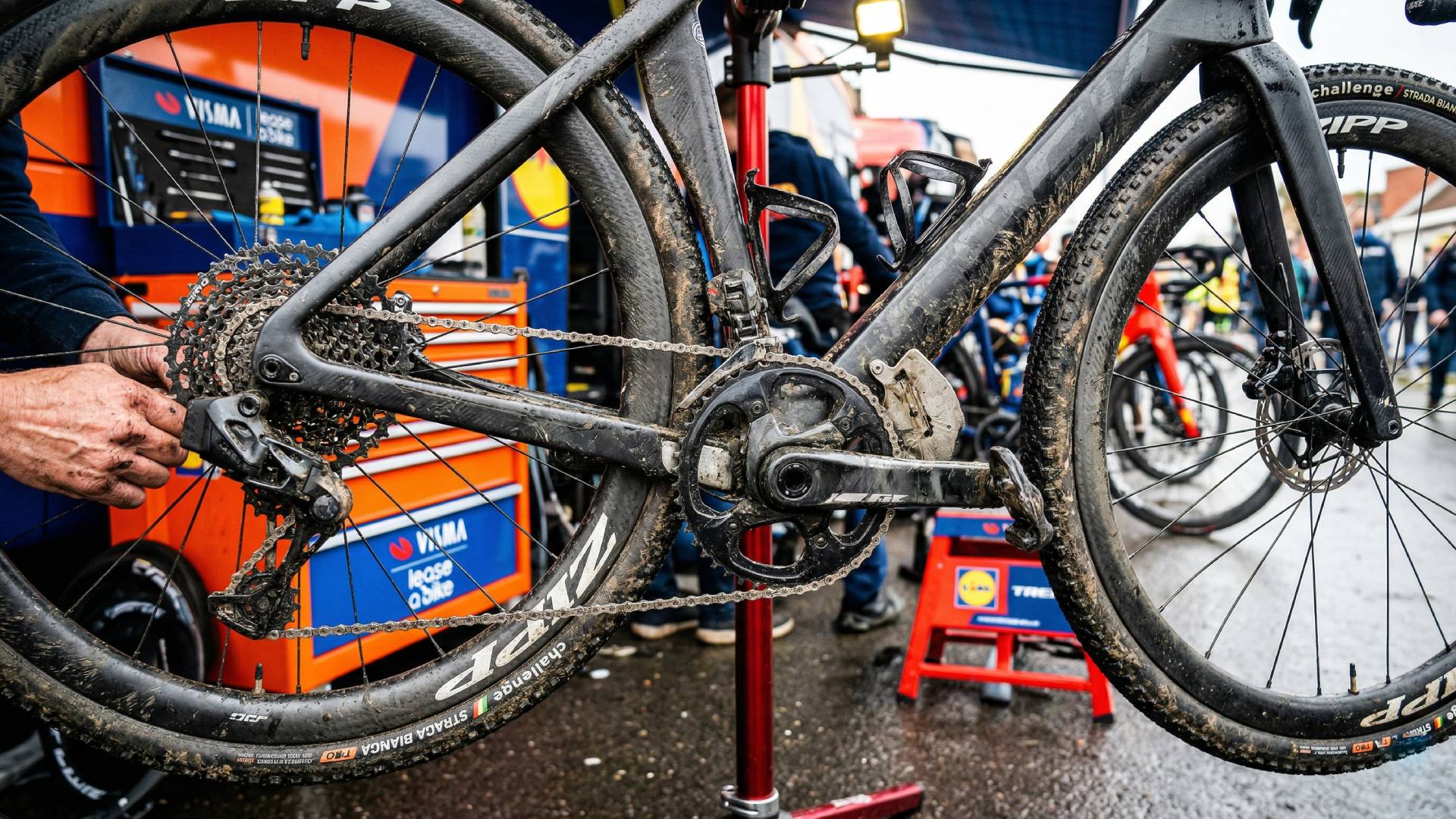
In a desperate attempt to stop chains from violently bouncing off the chainrings on the Koppenberg, teams like Visma | Lease a Bike and Lidl-Trek are ditching their front derailleurs entirely. They are opting for massive, single 54-tooth front chainrings paired with enormous rear cassettes. They are essentially running cyclocross setups, except they are trying to push 50 km/h on flat, windy highways before they hit the dirt.
The Return of the Double-Wrapped Bar Tape
The cycling industry has spent millions of dollars engineering proprietary, shock-absorbing carbon handlebars. And how do the pros utilize this cutting-edge space-age technology? They wrap it in two thick layers of cheap cork tape. Some mechanics are even taking it a step further and physically taping strips of gel orthopedics underneath the cork to keep the riders’ hands from blistering until they bleed.
Tires So Big They Barely Clear the Frame
Five years ago, riding 28mm tires on the road was considered a luxury reserved for endurance grandpas. This Sunday, almost the entire peloton will be running 32mm tubeless tires packed with foam inserts. The clearance between the rubber and the carbon fork is practically nonexistent. If a rider rides through a particularly thick patch of Belgian mud, it is going to act like sandpaper directly on the frame.
Custom 3D-Printed Chain Catchers
Even with the industry’s best electronic clutch derailleurs, the jagged stones of the Paterberg are undefeated against bicycle chains. To counter this, teams are secretly using custom, 3D-printed titanium chain catchers hidden behind the cranksets. They are unbranded, highly experimental, and absolutely necessary because dropping a chain on a 20% cobbled gradient means you are walking to the finish line.