


There is a sacred, unspoken contract in professional cycling. You can suffer, you can crash, and you can absolutely bury yourself in the gutter, but you must always attempt to look good doing it. We have spent the last decade arguing over the aerodynamic legality of sock heights, hiding our brake cables inside our headsets, and spending small fortunes on jerseys engineered in military-grade wind tunnels.
And then Jonas Vingegaard showed up to Stage 4 of Paris-Nice and took a massive, wattage-fueled dump all over the entire concept of aerodynamic efficiency.
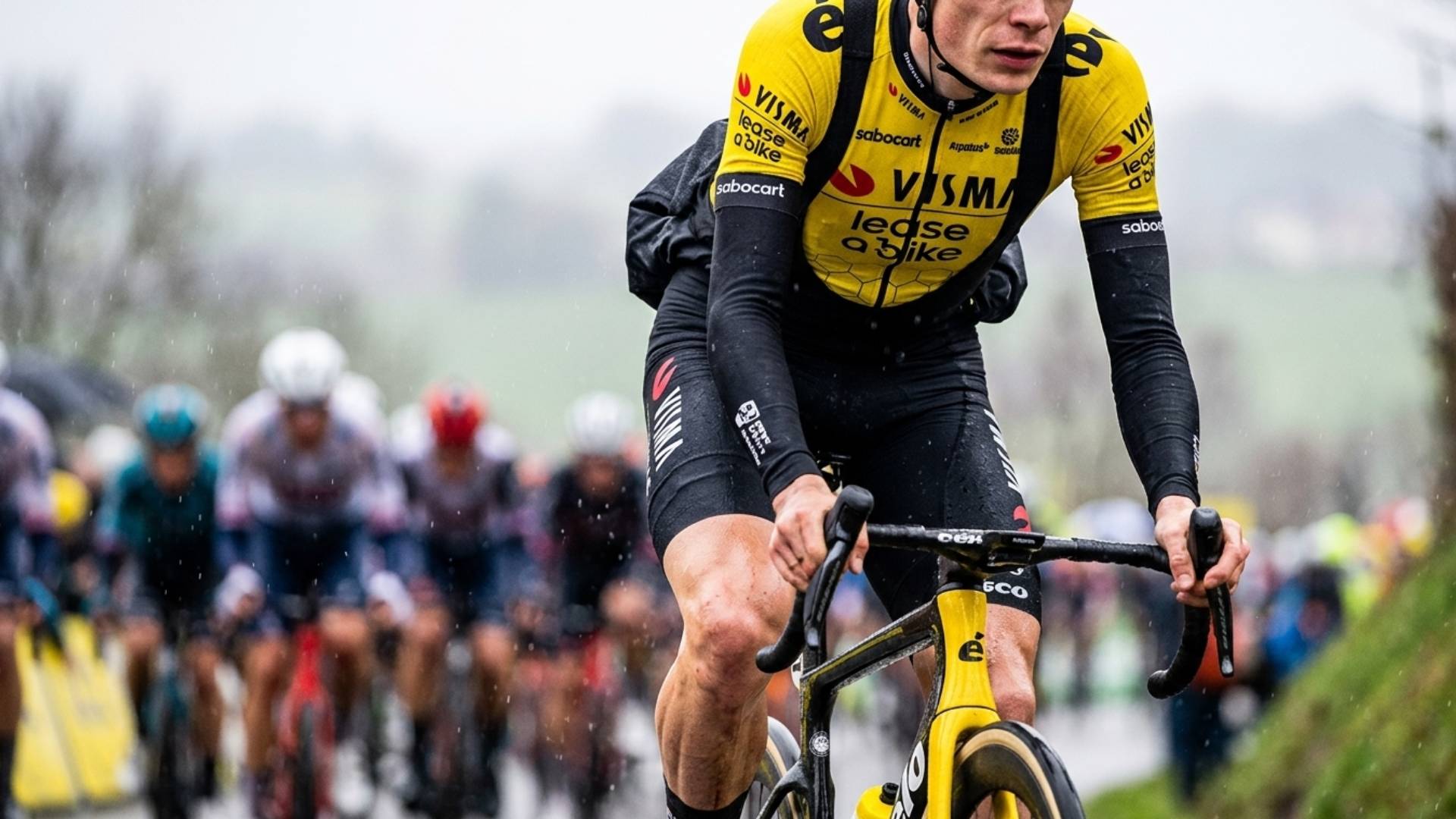
By now, you’ve seen the footage. After the crosswinds tore the peloton to pieces and crashes eliminated his primary GC rivals, Vingegaard found himself isolated at the front with four riders from Red Bull-Bora-Hansgrohe. It was freezing, it was raining, and the racing was so completely chaotic from kilometer zero that the Dane never had time to stop at the team car and strip off his winter training gear.
The Dungaree Demolition
So, how did the two-time Tour de France champion tackle the decisive 16 percent gradients of the Signal d’Uchon? Wearing his heavy thermal bib tights pulled up completely over his Visma | Lease a Bike jersey.
He looked like a chaotic commuter who had gotten dressed in the dark. He looked like a toddler who had proudly figured out how to put on his own pants. The aerodynamic drag coefficient of bunched-up thermal lycra acting as a parachute around his waist must have been astronomical.
And it didn’t matter at all.
Vingegaard simply danced on the pedals and rode away from the four-man Red Bull ambush like they were riding through wet cement. He dropped Daniel Felipe Martinez, soloed to the finish line, and comfortably slipped into the yellow jersey.
Wind Tunnels Are Officially Obsolete
After the stage, Vingegaard cheekily told the press, “Maybe I’m now a trendsetter by wearing my bibs over my jersey.”
No, Jonas. You aren’t a trendsetter. You are a physiological mutant who just sent a shockwave of sheer terror through the marketing departments of every major cycling apparel brand on the planet.
Think about the executives at Visma’s clothing and equipment sponsors today. They spend millions of dollars and thousands of hours inside wind tunnels tweaking the fabric texture on the back of a shoulder seam just to save 1.5 watts at 40 kilometers per hour. They sell the cycling public $350 aero jerseys by promising us free speed.
Then their marquee rider goes out and voluntarily donates 30 watts to aerodynamic drag because his legs are so unfathomably good he literally doesn’t need to care. Vingegaard proved the ultimate, cynical truth of modern cycling tech: all the wind-tunnel data in the world doesn’t mean a damn thing if you don’t have the V02 max to back it up.
So, next time your local ride buddy tries to justify his $4,000 aero wheelset, just remind him that the yellow jersey at Paris-Nice was won by a guy wearing his pants over his shirt. Save your money, folks. Just pedal harder.