


Striking the Sun – All Chapters
1975
Henri Giroud didn’t feel old, and from the outside he’d aged well, he thought. He’d never been particularly athletic, so his physical deterioration hadn’t hit him as hard as it might somebody who had taken pride in his body during his prime.
There was a moment as a young adult, when he was earning enough to afford rich meals, that he began to develop a tire around his waist. It was a gradual process, this slow accumulation of blubber, and in his mid-twenties he looked in the mirror late at night when he couldn’t sleep and vowed to return the more waiflike state of the Henri Giroud of his late teens.
It went on like this, his weight rising and falling, the tire not shifting much at either end of the extreme. Diets, positive thinking, and even the alien concept of cardio exercise could reduce his weight and make him fit into smaller chinos, but apparently couldn’t do anything about the tire, a ring of blubber that remained whether the rest of his body was in a state of scrawn or bulge.
After years of fighting, Giroud admitted defeat, bought some larger clothes, and allowed himself the excess his diets had denied him. The tire looked less strange once his body had filled out, and he took on a larger but more human shape.
People found him more fun now, and he grew confident. The larger Giroud finally understood who he was. It was immediately after he developed this understanding of his self that he met Maude, who has never seen him without the tire, not even in photographs.
Susan reached an arm across her desk without looking, feeling for her notes. She patted around knowing her notebook was somewhere around there, then stopped, pushed her chair back with a creak, and looked at her work space. The desk was messy, with paper and wires scattered in such a way that if she didn’t know she had an in-tray under there she would probably never have guessed. She counted five pairs of shoes underneath the desk, and bags of promotional material the newspaper had been sent. It was hard to know where to put her feet any more.
The accumulation of jackets on the back of her plastic desk chair had gotten out of hand, and it was beginning to resemble a Chesterfield armchair. People were having difficulty passing behind her. She folded a jacket into her bag, then sat back down.
In today’s article she was opining about a recent influx of superhero films. Expecting Hollywood to soon run out of protagonists, she suggested some bold new superheroes to turn into movies. She’d relinquish the rights to these creations for only 1% royalties, she playfully told the studios in her article, who, of course, weren’t among the handful of people reading.
“ConkerMan. AKA The Human Conker.
“Attacks enemies by coating himself in vinegar and swinging into them from a distance. Also, spiders won’t walk on him.”
Sometimes it felt like she was producing nonsense, spewing a steady stream of bollocks and expecting people to pay to read it, but with all the measures imposed on her, this had turned out to be the most productive week she’d had in months.
She could kill fifteen more minutes, then send the article over Nathan as she left for the day. That way she wouldn’t have to deal with anything or anyone until Monday morning. She took one final glance over the checklist in case there was something she’d missed that could cause her to get a call over the weekend, then rested content that she was done for the week.
In her first months at the paper, Susan had quickly become overburdened with work piled on her from all directions. It was funny to think about in the context of her more lasting experience at the company, since Jonah had panicked and pushed back, freeing the new arrival from this burden and pushing the work back onto its original owners. By this point there was almost no work left for her and she grew used to the vague satisfaction of being paid to do nothing, even it was hard to maintain the impression of doing work where there was no work to do. For almost two years, her sole obligation had been to copy and paste other people’s articles onto the content management system, and export weekly traffic data. Now finally Nathan had convinced Jonah there was more the company could be getting out of her. The checklist burning a hole in the desk out of the corner of her eye. It seemed like hardly anybody had read anything she’d ever put effort into, and even with this new added impetus she was finding it hard to break her old pattern of splurging her thoughts on to a page at the last minute and sending it over to be printed.
With her packed bag on her lap, she read through the article one more time, then emailed it to Nathan. If she wore her headphones on her ears and put her head down, she could leave the office without seeing Nathan, and having to reassure him that she’d just sent over the article he’d been waiting on. If she walked home she could get a little exercise, and listen to an album. She’d have to walk past the usual pubs and off-licenses and this time break her Friday evening routine, but putting her head down and walking would work for that too and she soon arrived at home.
The Mozart CD was still in the player. She didn’t really understand classical music, but maybe more exposure would help. With a book in her hand, it was easy to remember her childhood spent reading and writing constantly—young Susan was never far from a book or newspaper or magazine—but now it seemed like she was out of practice. Reading was hard. Even carving out a fifty page session was exhausting, chasing those words across the page while concentrating hard enough to be sure they still made sense. The same amount of time would fly by spent on the internet or watching TV. Soon she’d had enough, and went to bed early, and slept the whole way through the night for the first time in months.
She woke without feeling dehydrated—another unfamiliar experience—but out of habit filled an old beer glass she’d stolen from a pub in the bathroom sink, then drank the entire thing down, catching sight of her reflection. The Susan in the bathroom mirror was familiar. Her hair was scruffy, and her lopsided breasts pointed down toward the sink. Her waist teased at bulging outward just at the very bottom of the mirror. Avoiding her reflection had become her routine so much she’d stopped seeing herself anymore. She moved into the bedroom and moved the pile of dirty laundry from in front of the mirror, so she could really look at her body.
Susan felt sick to truly see this gradual weight gain and the unattractive pear shape her body had adopted. The triangle of pubic hair that once pointed straight at her feet now pointed at some point behind her, between her legs, as the bulge around her waist pushed its base outwards. Susan had grown heavy. She’d noticed the weight creeping up on her, but hadn’t been able to make herself stick to a diet. The person in her mirror was suddenly unfamiliar, and to be confronted with this new avatar nauseated her.
She wasn’t sure she’d ever eaten a full meal before she was thirteen years old, and then overnight her body had wanted to snack all the time, surging with pleasure from all the flavors she put in. The first thing she remembered finding delicious was a greasy takeaway pizza that her father had brought home one Friday night. It was incredible, better than anything she’d ever eaten before, and she slice after slice until her father got angry with her. That was the meal that flipped the switch, or the moment she realized the switch had been flipped.
Her body grew taller and changed shape over the next five years, and at eighteen, the growth spurt finally ended and Susan soon began to carry weight that rounded out her hips. This doughy form that had been alien for most of her life continued to creep up slowly over seven or eight months, and by the time she noticed it wasn’t her natural body shape it was too late.
She had lost weight shortly after she started her new life in London and found herself living, suddenly, on water and a couple hundred calories each day. The results were remarkable, and she swore she wouldn’t food corrupt her body any more. When she caved and ate something she craved more than anything, an event that happened perhaps two or three times total, she felt sick to the stomach, dizzy, furious with herself, and deeply regretful. By now she was carrying almost no extra weight, was a prime candidate for the thinnest person in any given room she entered, and would even scan the other candidates to rank her thinness in relation to them. Her body wasn’t its old shape but a new one; the triangle still pointed slightly behind as a result of the tiny tire around her waist that just wouldn’t shrink any more than it already had.
Her body remained within 2kg of this weight for the next year, with occasional lapses of bingeing followed by staid self-denial. And eventually her eating began to regain its original pace. She exercised less. Her body swelled back to the initial doughy shape, and then beyond. Some of it had been vanity, making herself more attractive. A large part, maybe, Susan found a thrill in taming her desire, demonstrating to herself what she was capable of and what she needed. But now she couldn’t recreate that thrill. When she’d deny herself food, her body would grumble for a couple of hours and then talk her into binges that made it clear that if anything self-denial had a net increase on her body weight.
It should be so easy. Quitting drinking would be the first step toward reducing her calorific intake, and eating healthier would take care of the rest. She’d exercise for fitness, and in no time the awful reflection in the mirror would have disappeared forever. Her sports bra was crumpled in a ball underneath her bed, covered in lint. She’d gotten out of breath crawling and stretching to reach it. Finding the rest of the tracksuit proved more difficult. The black tracksuit bottoms fit her better, but after what felt like 45 minutes of scrambling in closets and drawers, the blue pair fell onto her bedroom floor from underneath a sweater and she decided to settle. A half-hearted attempt at finding a suitable top led to her putting on a promotional Globe t-shirt she’d been given when she’d started at the newspaper years ago, and had never worn because it was too big. Now it was so tight she could see the outline of her naval. She sat on the sofa and tied her shoelaces, then instinctively turned on the television to check the time. It had already turned noon, and the parks would be full of people. She tried to pluck up the courage to leave anyway, to run past the strangers in the park, and then she unlaced her trainers.
Laden with guilt over her inability to exercise, she turned off the television and picked up her book. The Mozart CD felt like penance, but after ten minutes it was a penance she was no longer willing to endure. She scoured her CDs, then gave up and turned the television back on. By the afternoon she had exhausted her patience. She laced up her trainers again and went to the off-license in her tracksuit, after which she returned to the sofa, cracked open a bottle of red wine and spent the next five hours on the internet, half-listening the television. The blues hit; she was destined to be overweight and stupid for ever.
She had found the solution to the first problem, she thought, the quick fix for the fat girl who liked eating and drinking and not doing exercise. There was a pill called clenbuterol and it promised to raise her heart rate and her body temperature, tearing through calories like a cat through butter. She allowed herself to believe she’d be able to pop the pills before bed and be underweight the next morning.
She couldn’t buy clenbuterol legally, but she knew she’d be able find out where to get it. It took her another bottle of wine and two hours of research to be sure the internet-based vendor she’d found was legitimate, and then a further hour to see if she could find out anything about him. He was a plumber living in Merseyside.
The purchase was moneyless—a single page web form on ugly website, which told her the order was complete before she’d entered any payment details—and nothing happened for an hour or so. Then an email came through from an anonymous address, and contained only a bank account number and sort code. She wired the payment immediately.
The next day she bought two more bottles of wine and planted the seed from which this pattern of malaise continued for another five days straight. She wore her exercise clothes three days in a row, dropping them in a heap in front of the mirror on a night, then throwing them on again in a rush in the morning. When she arrived in the office on Monday wearing the tracksuit, Steve said “Been doing exercise have you,” as he walked past and she realized she was underdressed.
She woke on Tuesday morning with a headache that didn’t wane until she sipped from the warm, half-drunk glass of wine next to her bed. Today she wore jeans and a blouse, and spent fifteen minutes fixing her hair, arriving at work on time. A package was waiting on her desk. She had forgotten that drunken Saturday evening moment, but remembered now, and discretely put it the envelope in her bag and stepped away from her desk.
In the office bathroom with the loud fan spinning, she tore opened the small brown envelope and for a moment she wondered if it wasn’t something else; a flash drive or a press kit, maybe. But no, inside was a tiny pill bottle. Its label was written in Chinese, but clearly said Clenbuterol and the number 40mcg below the words Yabang Pharmaceutical. The lid made a satisfying pop when she thumbed it open, but the seal inside was broken. She’d read about this during her research, that the seller would break the seal to put bubble wrap inside to stop the pills rattling in the post, but there was no bubble wrap in this bottle. When she held a pill up to the fluorescent light, it didn’t look anything special, just a small white speck. What harm could it do? She took the pill—so tiny, and already beginning to dissolve on her tongue even in the short time it took her to put her mouth underneath the bathroom tap—and waited for this feeling inside, the feeling that her body was blazing through excess energy.
Without the innocent central nervous system of a young professional cyclist, the pill felt like nothing. Her heart rate was supposed to be raised, she’d get the twitches and the shakes, she’d feel uncomfortably hot. None of this happened. She got a little warmer and felt her heart beat the tiniest heavier, but then put it down to her mind.
One web page contained a discussion that took place eighteen months ago. A photograph of a pill bottle accompanied by an out of focus photograph of a single pill in the blistered palm of the thread author’s hand. “Is my clen legit?” The author made it clear that he or she had noticed no sides while using it.
Nathan walked past behind her.
“How’s it going?” He said.
“I’m just working through the spreadsheet,” she said, scrolling down the page looking for an answer to the question.
“I ask because it looks like you’re on social media. It’s the final week. We need the entire magazine ready for print on Friday evening.”
Most of the arguments on the forum were based on hearsay, and little of what anybody claimed was backed up with scientific research, though she’d already discovered scientific research into clenbuterol was somewhat lacking, with limited peer-reviewed papers on the dangers and effects of the drug. The least vehement posts suggested that even with no side effects, the clenbuterol was likely to be real: clenbuterol was so cheap to produce it was almost completely pointless to fake. With Nathan now out of sight, she put another pill into her mouth, but it dissolved into nothing on her tongue and had no effect on her body.
On Wednesday she woke up and took two pills with her morning coffee. She found it hard to concentrate, but the checklist guided her, absorbing her focus as she worked from top to bottom through the list. She didn’t need to think or be creative, she just needed to be a machine, ticking through the boxes one by one.
At lunch she drank two and a half pints of cider in a nearby pub before popping two more pills in the office bathroom and returning to her desk. If the pills were real, she was now up to a 160mcg dose, but still she felt nothing.
She was coming down with a cold or the flu. Her sinuses dried and throbbed. Her head ached and it was hard to focus too much on anything other than the checklist and her computer monitor. The rest of the office darkened in her peripheral vision and became quiet and distant. Perhaps this was for the best. When she stood up to leave, she made a concerted effort to not reveal how dizzy she was.
Susan’s throat infection left her struggling to swallow, and resembled choking just enough to make sleeping a convoluted affair of brief immersions punctuated with rapid, panicked awakenings. Without sleep, her condition deteriorated further.
By the next morning she didn’t feel like she was there at all. She became aware of her surroundings an hour into the work day while staring at the checklist, feeling worse than she ever had, and she couldn’t remember arriving at work. Nathan was stood over her and she said “I’ve been hitting the numbers,” while pouring vodka into her coffee mug, but couldn’t remember if it was real or a dream.
She drank beer and then wine until the torture inside her head waned, and spent the evening in bed running a temperature and coughing, writhing in sweat with a pounding headache as much from the lack of sleep as the sickness itself, at some point floating over to the sofa in the next room, where she hid underneath a blanket and watched television in a haze.
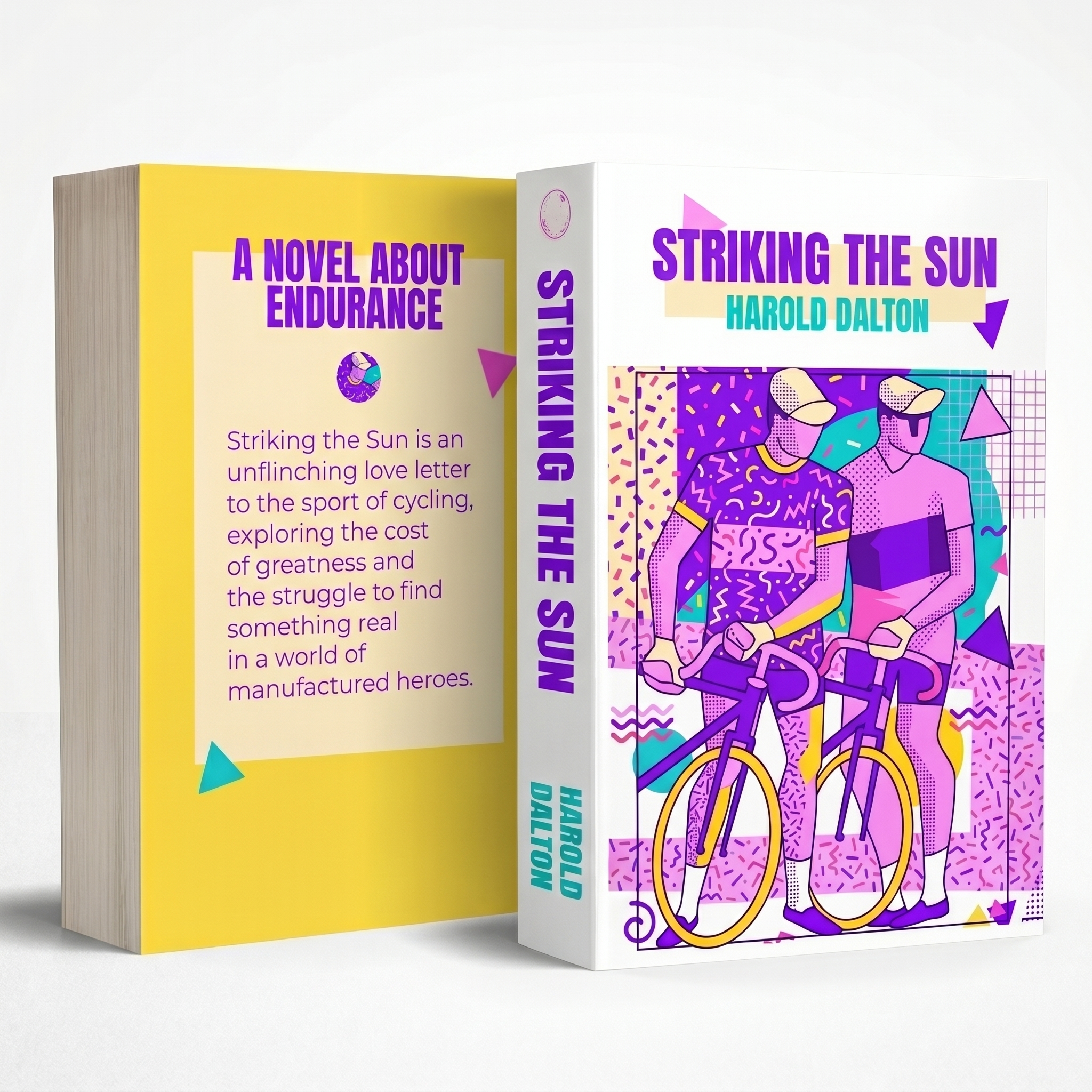
Hold it in your hands
The complete serialized novel is also available in a limited physical print run.
VIEW THE PAPERBACK →