

Here’s an underrated thing about Striking the Sun. When the print proofs arrived, I held the copy up in my hand and said, “You can pick any page and there will be something ridiculous happening.” My wife yelled out a page number. I read out the first words on the page: ‘”ConkerMan. AKA The Human Conker. Attacks enemies by coating himself in vinegar and swinging into them from a distance. Also, spiders won’t walk on him.” …Sometimes it felt like she was producing nonsense.’
And so I would, in this long, depressing slog that feels neverending, encourage you to view the book as a comedy.
Before we dive in, here’s a note I won’t otherwise dwell on: this is Henri Giroud’s first unmediated appearance in the novel, at page 98. Until then, we’ve seen him on screens, heard his voice, seen him in viral videos. Now we’re actually with him as a narrator, there’s an immediate contrast with the mediated version. If Part One belongs to Susan, Part Two belongs to Giroud, and we’re beginning to move toward that baton pass.
Mirror Maze
We’ve discussed the pairing of seemingly disparate plotlines as a way of building a broader thematic message. In this chapter, we’re not doing this subtly at all. Giroud’s body in 1975 and Susan’s body in 2011 refract rather than reflect one another, and the black market asthma drugs Susan uses to gain control over her body are the same as the boys use in the next chapter. (As an aside, Striking the Sun intentionally shies away from doping; these nods serve to show that while it is happening, the Omerta extends even to the memoir.)
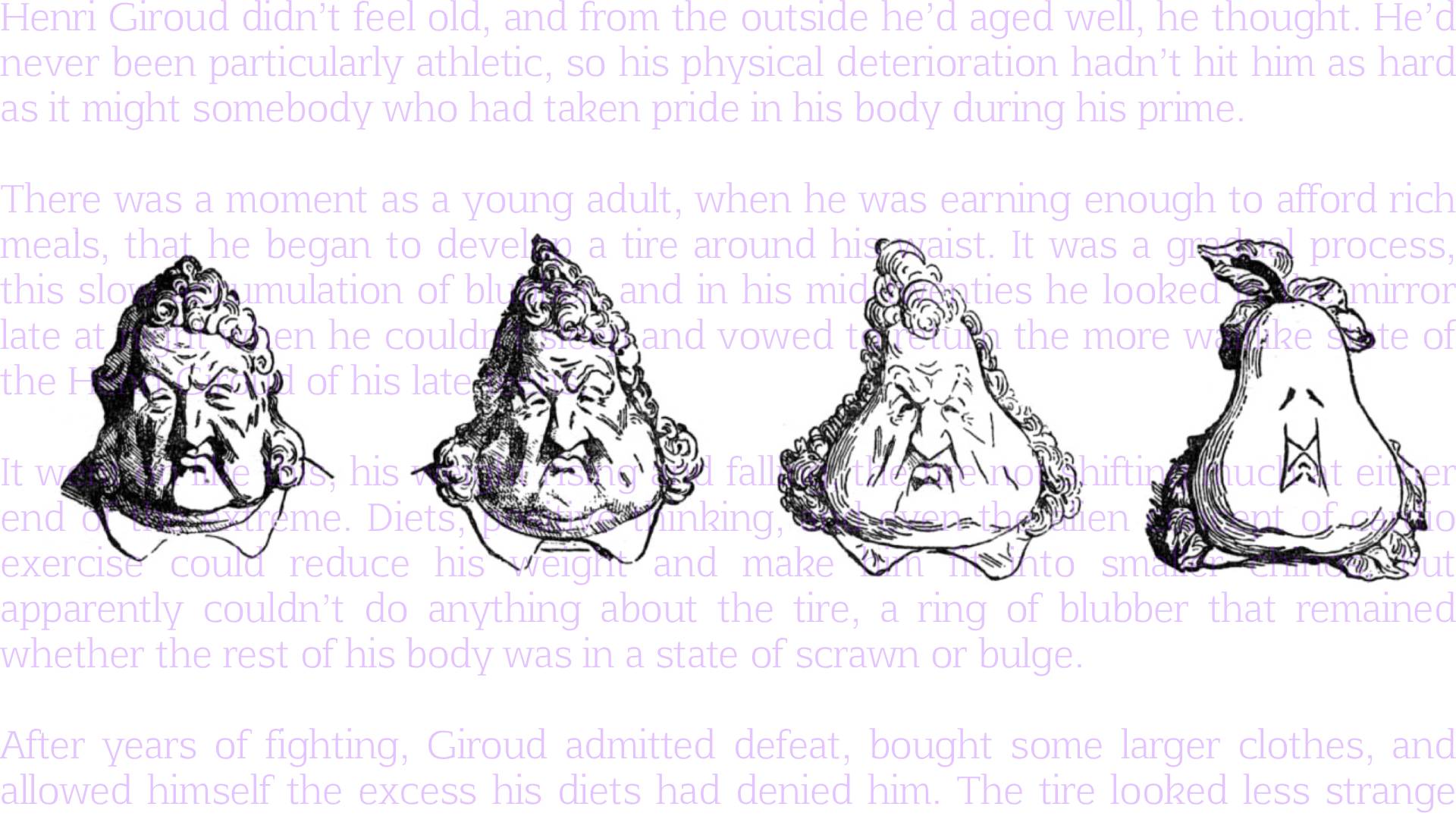
In this chapter, the shared use of the word “tire” to describe both Henri’s and Susan’s bodies is a thematic (albeit unnecessary) anchor. Henri’s decision to stop being disgusted by his body and allow himself to take on a “more human shape” is the exact catalyst for his confidence and his connection with Maude. It proves that shedding the “spectacle” (the obsession with a waiflike, idealized image) is the path to authentic humanity in this universe.
Conversely, Susan remains entirely trapped by the spectacle. She still scans rooms to “rank her thinness,” letting her self-worth be dictated by an impossible comparative metric. What we’re really doing, even at this early stage, is establishing that Susan is at her rock bottom, even if she doesn’t yet understand that’s where she is.
Slow-Burn Rock Bottom
I wanted Susan’s story to be a more honest depiction of collapse than we often see in fiction, where it’s usually a dramatic, earth-shattering moment.
In reality, rock bottom is exactly what Susan is doing. It even manifests in small ways: wearing the same promotional t-shirt three days in a row, drinking warm wine from a stolen pub glass, and executing a meaningless checklist while telling herself she’s just in a bit of a rut. She is no longer living.
People dip in and out of the story, and with Susan existing rigidly in the present, you can expect her to drop out briefly while the other two characters catch up. This break might be a relief to some readers, though she is an important character. At the same time, I wanted her to be the passive hero(ine)–we realize her situation and what she needs to do before she does, and at one point in Part Three her passiveness doesn’t just undermine her, but undermines the novel itself, ruining the first major point of convergence at one of the most dramatic sections in the book. I want you to be yelling at the book in those moments and then, if you’re brave enough, yelling at yourself too.
1. An Administrative Narcotic
In Chapter 8, the checklist Nathan provided felt like a trap that Susan was failing to navigate. By Chapter 10, the checklist has become her survival mechanism.
“She didn’t need to think or be creative, she just needed to be a machine, ticking through the boxes one by one.”
She uses the administrative drudgery to intentionally numb herself, pairing it with the alcohol and the Clenbuterol so she doesn’t have to exist in reality.
2. The Numbness of the Flesh
There’s an unsettling contrast between how the cyclists experience Clenbuterol in the next chapter and how Susan experiences it here.
Susan expects an electric reaction, shakes, a racing heart. Instead, her body is so depressed, atrophied, and drowning in a constant drip of cheap alcohol that the 160mcg dose of black-market Clenbuterol barely registers.
“Without the innocent central nervous system of a young professional cyclist, the pill felt like nothing.”
The magic pill of the professional athlete cannot penetrate her physical and spiritual burnout. She’s looking for the easy answer, the cheat code, and it only makes things worse.
3. Stasis Architecture
The description of Susan’s desk is a visual metaphor for her psychological state. The five pairs of shoes and the accumulation of jackets transforming her plastic chair into a “Chesterfield armchair” show that she is physically nesting. She is building a bunker out of her own detritus. Just as she retreated to the darkness of the bathroom with the oscillating fan, she is now constructing a barricade right in the middle of the open-plan office. She is present in body, but absent in spirit.
But There Is Hope
Susan’s timeline is agonizingly slow in Part One. Her narrative grinds down to the day-by-day, hour-by-hour minutiae of drinking, failing to run, scrolling the internet, and surviving the office, the novel’s present feels claustrophobic, an inescapable, attritional reality. (This is intentional in a few ways, one being that I wanted to structure the novel like a bicycle race.) Susan casually pouring vodka into her coffee mug while telling Nathan “I’ve been hitting the numbers” is a haunting image of high-functioning collapse.
But as Susan’s present timeline represents the future for Dominic, so does Giroud’s plot represent the future for Susan. I said the scene pairings for this chapter were obvious, and they are: things do get better.